“The idea to combine solar panels and blinds struck me when I saw sunflowers in the field turning to face the sun.”
Yevgen Erik, founder and CEO, to Yanko Design, February 20206
Nature has been optimizing sunlight for millions of years.
From an organic principle to a precise geometry.
Inspired by nature. Engineered for architecture.
3D illustration
Scroll
World’s first smart solar blindsEvery windowcan changethe world.
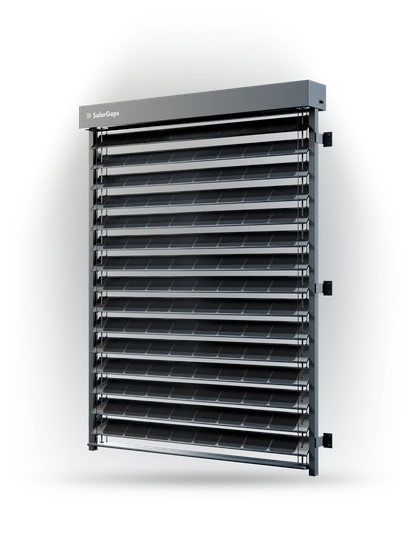
External solar blinds that generate electricity, manage sunlight and redefine the relationship between architecture and energy.
Many blinds sold as “solar” use a small panel that only powers the motor. On SolarGaps blinds, every lamella carries solar cells and generates electricity.
Arrow keys rotate the model, Page Up and Page Down zoom, and Shift with the arrow keys moves it.
Loading 3D model
The 3D model could not be loaded.
Play animation
Pause
Play again
Stop paying to cool down the sun.
SolarGaps blocks the heat outside the glass and turns the same sunlight into electricity. One façade, three jobs.4
Block heat
Stops the sun’s heat outside the glass, before it enters the building.
Generate
Solar cells on every lamella turn the same sunlight into electricity.
Save energy
Less heat to remove means lower air-conditioning costs.
36%
According to the EU, buildings are responsible for more than 36% of CO₂ emissions while being the biggest electricity consumers.10company statement, quoted from SolarGaps’ presentation
The problems it solves.
SolarGaps states that its blinds cut electricity bills by up to 30% and pay for themselves.10 That is the company’s figure. The calculator on the Resources page shows the method for your own building.
The problem
What SolarGaps does
What the building gets
Sun through the glass heats the rooms, and the air conditioning works all afternoon to remove that heat.
Block heatLamellas outside the glass stop direct sun before it becomes heat in the room.
Lower cooling costsSolarGaps states that external shading can cut heat gain to almost zero and air-conditioning costs by more than 70%.10Company figure.
A roof is too small to power the building below it, and the façade produces nothing.
GenerateSolar cells on every lamella: up to 100 W per m² of blind in full sun, according to SolarGaps.10
Energy generationPower for the building’s own operations, produced while the sun is on the façade.
Buildings create 36% of the EU’s energy-related greenhouse gas emissions.11
Save energyLess cooling plus on-site generation, both logged in the SolarGaps app.
Energy-friendly buildingData that supports green building certifications such as LEED and BREEAM.10No certification points are promised.
Tenants and investors now ask how green and how comfortable a building is.
All three at onceA façade that visibly works with the sun.
Property promotion and green reputationSolarGaps names attracting top-level tenants, a higher rent margin and a greener company reputation as benefits.10Company claims.
Block heat, generate, save energy: SolarGaps’ own three-part promise.4 Product image: 3D render by Inédito of the site’s 3D model, built from the patent drawings and SolarGaps’ photos.
03 Our mission
Open every window to free energy.
SolarGaps invented the first external smart blinds with built-in solar panels. They shade the glass from outside, producing electricity while keeping the building cool.10
2016foundedSolarGaps Inc. incorporated in Delaware, August 201612
11countries with official distributorslisted on solargaps.com8
12employeesSEC filings 2021–2412; core team of about seven in 20247
300+installations worldwidecompany figure; the presentation also says 350+
35countries reachedcompany figure; no list published
Grey notes give the source. Notes with a yellow dot mark SolarGaps’ own figures, not yet confirmed independently.
Recognition
Awards and programmes as listed by SolarGaps,4,10 checked against the organisers where their records are public.
2021NaN Arquitectura awardnot yet confirmed by the organiser
2020German Design Award, winner, Building Elementslisted in the organiser’s winners gallery
2020Katerva Awards 2020: finalist, and People’s Choice in Energy & Environment, shared with Reefballconfirmed in the organiser’s archive21
2019The smarter E AWARD, winner, Smart Renewable Energyconfirmed by the organiser14
2018COP 24: UN and EBRD Special Climate Innovation Awardnot yet confirmed by the organiser
2018Amazon Innovation Center China awardnot yet confirmed by the organiser
2018TechTour, Top Presenting Companynot yet confirmed by the organiser
Also confirmed: two EU Horizon 2020 grants, EUR 50,000 in 2017–18 and EUR 995,935 in 2019–21,13 and a EUR 50,000 Climate Innovation Vouchers grant from the EBRD and EU programme run by Greencubator.15 Listed by SolarGaps: Singularity University programme at NASA Ames (2016), HAX accelerator and SVIEF-Star startup contest (2017), Expo 2020 Dubai (2021).4,10 The logos are from SolarGaps’ presentation; each organiser should approve their use before launch.
Imagine a world where every building does more than consume energy.
Imagine a world where every building can produce it.
A world where every window has the potential to become a small power plant.
A world where millions of homes, offices, schools, hospitals, and skyscrapers become part of a connected, distributed energy system.
This is not science fiction.
This is a future we can start building today.
Yevgen Erik, Founder of SolarGaps20
The solar panels on Erik’s own roof did not cover his air-conditioning costs in summer. He imagined blinds that would track the sun like a sunflower and shade the house at the same time.7“I saw how we need to take something from nature and bring it to our homes.”7
He took the idea to the IoT Hub accelerator in Kyiv, formed a team and launched SolarGaps in 2016. A Kickstarter campaign more than doubled its target, raising over 102,000 dollars.7
2016SolarGaps Inc. incorporated in Delaware in August;12 Singularity University programme at NASA Ames; first patent received.4,7,10
2022Russia’s full-scale invasion of Ukraine on 24 February. Team members leave for defence production and the front line; costs are cut to keep the Ukrainian factory running. Operations continue.7
2023European patent EP 3 938 612 B1 granted; it has since lapsed in 24 of its 38 states, including Norway, Sweden, Finland and Denmark.3
2024US patent 11,905,757 B2 granted.3
Preliminary timeline, combined from solargaps.com, SolarGaps’ company presentation and press. Yevgen Erik is reviewing the dates and events.