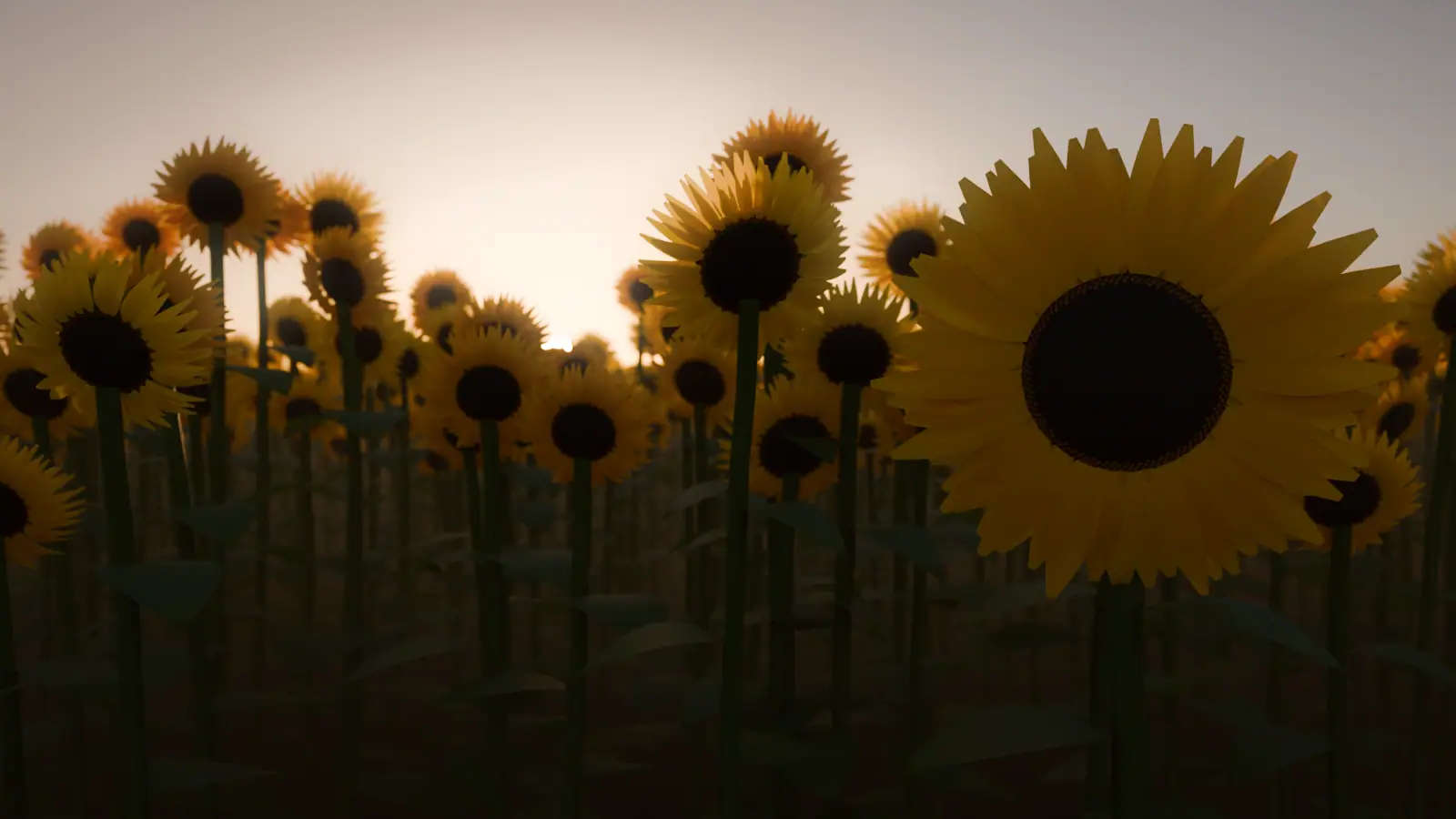
A sunflower field at sunset, the flowers facing the camera with the low sun behind them. 3D render.

“The idea to combine solar panels and blinds struck me when I saw sunflowers in the field turning to face the sun.”

Yevgen Erik, founder and CEO, to Yanko Design, February 20206
01 Nature invented the principle

Nature has been optimizing sunlight for millions of years.

External solar shading stops the sun before it reaches the glass. SolarGaps blinds do this with tilting lamellas that also generate electricity. SolarGaps was inspired by a simple observation: nature adapts to the movement of the sun.

01 Transformation

From an organic principle to a precise geometry.

A young sunflower follows the sun from east to west during the day and turns back east overnight.1 Its seeds spiral out at a constant 137.5°, the golden angle.9

01 Engineering

Inspired by nature. Engineered for architecture.

Sunflower→Sunlight orientation→Solar tracking→Intelligent solar façade

3D render. Mature sunflowers face east all day, so at sunset they are lit from behind.1
02 Sunrise to sunset

Same sun. Two ways of following it.

Move the sun through a clear June day in Oslo. The sunflower turns its head toward the sun’s compass direction. The SolarGaps lamellas tilt about their horizontal axis toward the sun’s height as seen in the section of the façade.

Sunflower, seen from above

Analogy: follows the sun’s azimuth. Simplified biology.1

SolarGaps lamellas, seen in section

Product behaviour: the drive changes the inclination angle.3 The sun is drawn at its angle in this section, not at its height above the horizon.

06:0009:0012:0015:0018:0021:00
12:00solar time, Oslo, 21 June
0°solar altitude
0°sun’s angle in the section
0°lamella angle from horizontal
0 Willustrative, per m² of blind

The analogy is the principle, not the mechanism. A sunflower turns sideways to follow the sun’s compass direction. SolarGaps lamellas do not swivel sideways: they rotate about their own horizontal axis, so what they follow is the sun’s angle in the vertical section of the façade, called the profile angle. That is why, on a south façade in summer, the lamellas move less than the sunflower does. Energy values are from a simplified clear-sky model, not a measurement.

03 How it works

Every part, in three dimensions.

The same detailed model as on the homepage. Turn it, zoom in on a lamella, and switch on the wiring to follow the current from the cells to the socket.

Full screen

Drag to turn. Click the model to zoom with the wheel, or hold Ctrl or ⌘ and scroll.Scroll to zoom, right-drag to move. Esc or a click outside gives the page its scroll back.Swipe sideways to turn. Tap the model to zoom and move it.Pinch to zoom, drag with two fingers to move. Tap outside the model to scroll the page.

Arrow keys rotate the model, Page Up and Page Down zoom, and Shift with the arrow keys moves it.

Loading 3D model

04 Colour

Choose your colour.

SolarGaps’ colour samples hold 21 finishes: RAL whites, greys and colours, metallics and a golden oak wood foil.17 The colour goes on the frame (headbox, guide rails and bottom rail) and on the backs of the blades; the solar cells stay the same.19 Pick one to see it on the model.

Screen colours are approximate. Final colour from a physical RAL sample.

Loading 3D model

Frame and blade backs

The cells on the front never change.

Whites and neutrals

Greys and anthracite

Metallics

Colours

Wood

Screen colours are approximate. Final colour from a physical RAL sample.

The colour is on the frame and on the backs of the blades. The solar cells on the front stay the same.19 SolarGaps shows the same dark cells in every colour and publishes no difference in output between colours.16

Codes: SolarGaps’ colour samples.17 RAL names and screen values: RAL gGmbH; VSR and DB colours: sun-protection colour cards.18 DB 703: screen value estimated. 7016 S: “S” read as a fine-structure finish, to be confirmed. Golden oak: an illustration of a wood foil, not its real pattern. “Most popular”: SolarGaps’ word for anthracite.16

05 Sunlight, shading and energy

The sun moves. Your building responds.

Time of day12:00
060912151821
Façade faces
Lamellastracking
View
0°solar altitude
0°sun azimuth
0°sun to façade normal
0°lamella angle
0direct sun on glass, conventional, W/m²
0with SolarGaps, W/m²
0PV output, W per m² of blind
0%direct sun passing the lamellas
Assumptions and limitations
  • Simplified model for illustration. Not a certified engineering or energy simulation.
  • Sun position from standard solar geometry (declination, hour angle, latitude), solar time.
  • Direct beam only, clear sky (Meinel approximation). Diffuse and reflected light, frames, glazing properties, thermal mass and ventilation are not modelled.
  • PV output scales SolarGaps’ rated 100 W per m² by beam intensity, angle of incidence on the panel and shading between lamellas (2-D geometry, pitch 110 mm, depth 85 mm).
  • Tracking: the lamella turns its panel toward the sun’s profile angle, limited to 8–82° in this model. SolarGaps’ manual gives a slat adjustment range of 70° to −30°; the control logic is not published, and the patent states the angle is set from illumination inside and/or outside the room.

Façade model: illustrative 3D scene. Lamella pitch and depth from the product model, not from manufacturer drawings.

06 From passive façades to active energy systems

What if buildings could generate more value from the sun?

One envelope element, three simultaneous functions. The section below follows the same beam of sunlight with and without SolarGaps.

Conventional glazingsection
InsideOutside ReflectedSolar heat gainDirect sun reaches the glassGlare and overheating risk
Glazing with SolarGapssection
InsideOutside InverterElectricity to the buildingHeat releasedoutdoorsLamellas intercept direct sunControlled daylight
Incident sunlightElectricity, to the shared bus Reflected lightSolar heat gainInterior daylight

Not all intercepted sunlight becomes electricity. The SunPower cells on each lamella are rated at 22.4% cell efficiency.2 Most of the remaining energy is reflected or warms the lamella, which sits outside the glass, so that heat is released to the outdoor air instead of the room. This is general building physics; the amount depends on the project and is not quantified here.

01

Generate energy

Photovoltaic elements on every lamella convert incident sunlight into electricity. A certified micro-inverter turns the direct current into alternating current for the building.2

02

Manage solar heat

External shading intercepts direct solar radiation before it reaches the glazing, which is where interior blinds cannot act.2

03

Control daylight

The drive changes the lamella angle as a function of illumination inside and outside the room, balancing darkening against energy collection.3

How solar blinds compare with solar glass, solar panels and plain external blinds.

PropertySolarGapsRegular external blindsSolar glassSolar panels
Peak power per m²100 Wnone60 W200 W
Shadinghighhighmediumnone
Daylight controlyesyesnono
Fitting to a windoweasyeasyreplace the glazingnot for windows

SolarGaps’ own comparison.10 The presentation gives power as “Wh per sq.m”; the numbers describe peak watts per m², so they are shown that way here. Shading is SolarGaps’ star rating in words. Typical values, not measurements from a project.

External venetian blinds or roller shutters?

A roller shutter closes off the whole window. An external venetian blind has tilting lamellas, so you can adjust shade and daylight. SolarGaps blinds also generate electricity.

What is solar shading?

Systems that protect glazing from the sun: brise soleil, external venetian blinds, awnings. External systems stop the heat before it enters the building.

Internal or external shading: which keeps out more heat?

External shading. It stops the sun before it reaches the glass. Internal shading hangs behind the glass, so by then the heat is already inside.

How wind-resistant are external blinds?

SolarGaps states wind class 2 under EN 13561 (manufacturer’s declaration, 2018; no third-party test).22