A preliminary scenario from real irradiation data for your location and façade direction. Every result shows its method; where inputs are missing, the result asks for them instead of guessing.
Preliminary scenario
—Estimated energy production, kWh/yearPVGIS 5.3 yield × rated power × assumptions
—Estimated electricity value per yearenter a price per kWh
—Avoided grid emissions, kg CO₂e/yearenter your grid factor (location-based method)
—Simple payback, yearsenter installed cost and price
Monthly production, low and high case
Cooling energy impact: not estimated. It depends on glazing, internal loads, HVAC system and climate, and needs a building energy model. Request a professional assessment →
SolarGaps worked with the Austrian engineering firm iC consulenten to test its blinds in a model office room: 8.7 × 7.5 m, 3.9 m high, in Kyiv and Barcelona.10 The room was simulated in DesignBuilder/EnergyPlus and the generation compared with PVGIS. Cooling made up 25–50% of the room’s energy use in Kyiv and 45–70% in Barcelona, depending on climate and orientation. The full report is not public; the findings below are SolarGaps’ summary.
The largest savings were for south-facing windows in warm, humid climates.
A lamella angle of 70° was the best compromise between generation and cooling in most cases.
Used in summer, the blinds cut cooling energy markedly, most of all for rooms with large windows facing south, south-east or south-west.
Energy saved per year in the study’s model room, about three and a half times as much with SolarGaps. Values read from the study chart; the chart is labelled “kW/year”, where kWh per year is meant, and does not say which city it shows.10
70° tilt, kWh per kWp a year
Study
PVGIS 5.3, our check
Kyiv, south
900–1,000
983
Kyiv, south-east / south-west
900–1,000
915 / 893
Barcelona, south
1,300–1,400
1,373
Barcelona, south-east / south-west
1,300–1,400
1,232 / 1,274
Our check: PVGIS 5.3, fixed 70° tilt, 14% system losses, run 29 Oct 2026. South-facing results match the study; south-east and south-west fall below its range. PVGIS assumes an unshaded panel, so lamellas that partly shade each other are likely to yield somewhat less.
02 Designed for professional specification
From concept to construction.
What exists today, what SolarGaps can supply on request, and what has to be produced before a specification can be written. Nothing here is a placeholder file pretending to be a document.
Product documentation
Product overview and specificationspublic, solargaps.com
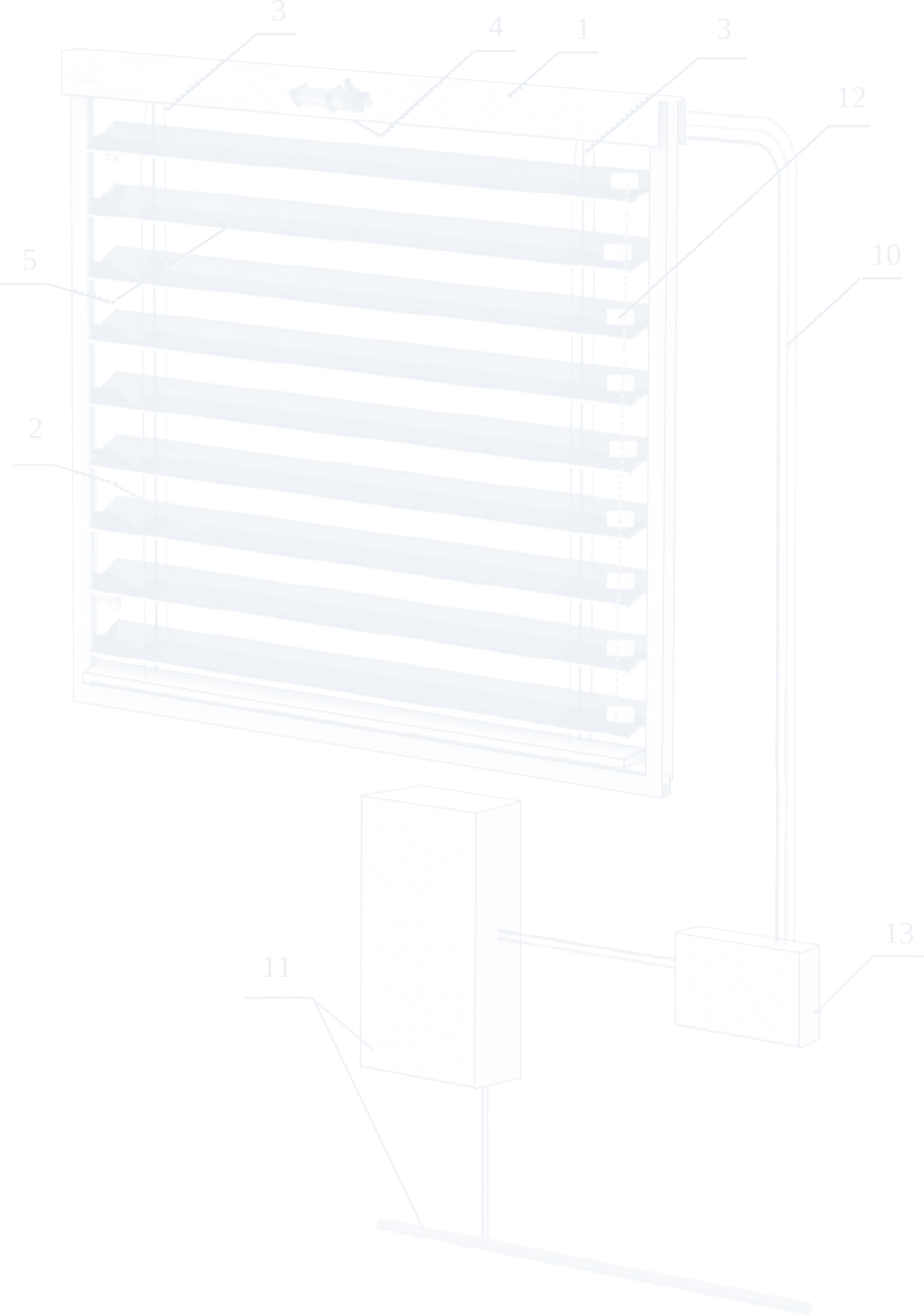
Fig. 1 — overall view of the photoelectric blinds. Drag to pan, scroll or pinch to zoom.
Patent library
Photoelectric window blinds
Publication
Jurisdiction
Status*
US 11,905,757 B2
United States
Granted 20 Feb 2024; adjusted expiry 19 Apr 2041
EP 3 938 612 B1
European Patent Office
Granted 15 Mar 2023; lapsed in 24 of 38 states, renewal fees paid in 9 (Google Patents, 11 Nov 2026)
ES 2 952 508 T3
Spain (EP validation)
Active
WO 2020/159467 A1
PCT/UA2020/000007
International phase ended (normal)
a 2019 00923
Ukraine, priority
Priority date 29 Jan 2019
Inventor: Erik Yevgen Valeriiovych. Assignee listed by Google Patents: individual. *Legal status as shown by Google Patents on 13 Oct 2026, which is not a legal opinion. Protection applies only in the listed jurisdictions; no worldwide protection is implied.3
What it protects, in one sentence: lamellas with a C-shaped profile whose curved edges hold a solar panel made of sections on an insulating base under a protective layer, with a DC/DC transformer or Schottky diode in one edge section of each panel, coupled to a shared bus and a DC-to-AC converter. Connecting the panels in parallel, or in series and parallel, is set out in two dependent claims.
External installation only; units are mounted outside the glazing with steel cable or rigid side guides.2 The manual describes the brackets and anchors for each wall type and gives a weight of 10 ± 1 kg/m².22 Structural loads, CAD and BIM details are not published. Request an engineering consultation.
Environmental durability
Operating range −20 °C to 60 °C at 20% relative humidity, −10 °C to 40 °C at 80%.2 Panel lifespan at least 25 years; system lifespan at least 10 years; 2-year warranty.2
The cells are SunPower Maxeon, under an ETFE coating that SolarGaps gives a service life of more than 30 years.10 The “92% output in year 25” in SolarGaps’ presentation is Maxeon’s warranty for its own panels, not a SolarGaps warranty.
In snow, the blinds must be fully retracted to avoid freezing and the extra weight of snow.5 The manual also advises against moving the blinds at subfreezing temperatures and recommends keeping them up in frost.22 For Nordic projects this belongs in the control strategy and the winter energy estimate.
Electrical connection
The cell sections are joined by water-proof plug-in connectors, and each panel is coupled to a shared bus.3 A certified micro-inverter, 95% average efficiency and 24 V minimum input, converts to alternating current; the system can also feed battery storage.2
Maintenance and cleaning
The ETFE-coated panel surface is designed to be self-cleaning; most dirt is washed off by rain and snowmelt.2 The manual still asks for periodic cleaning with the blinds disconnected from the grid, and an inspection once a year by authorised personnel.22 Access for large façades is not covered.
Retrofit feasibility
The patent describes plug-in connections so units can be fitted to window openings of many sizes, including on existing buildings.3 Units range from 85 × 85 cm to 320 × 300 cm.5
Fire and building codes
No fire classification or code compliance documents are published. These must be supplied per market before specification.
Wind exposure
Described as wind resistant and tested with an air gun.2 SolarGaps’ own declaration of performance gives wind load resistance Class 2 under EN 13561 (2018, no third-party test).22 High-rise use needs project-specific confirmation.
Automation and building management
SolarGaps’ electronic management device sets the lamella position and sends data to a cloud platform and app, where owners see performance reports, set scenarios and control the blinds remotely.2,10 Control by app, Amazon Alexa, Google Assistant, EnOcean switch, Somfy RTS remote, a wired wall switch or a manual winding crank.2,10
SolarGaps states that the blinds can be integrated into almost any building management system, and lists BMS integrations for the B2B sector as a 2022 milestone.10 The supported protocols, such as KNX, BACnet or Modbus, are not named. Ask SolarGaps for the integration document.